
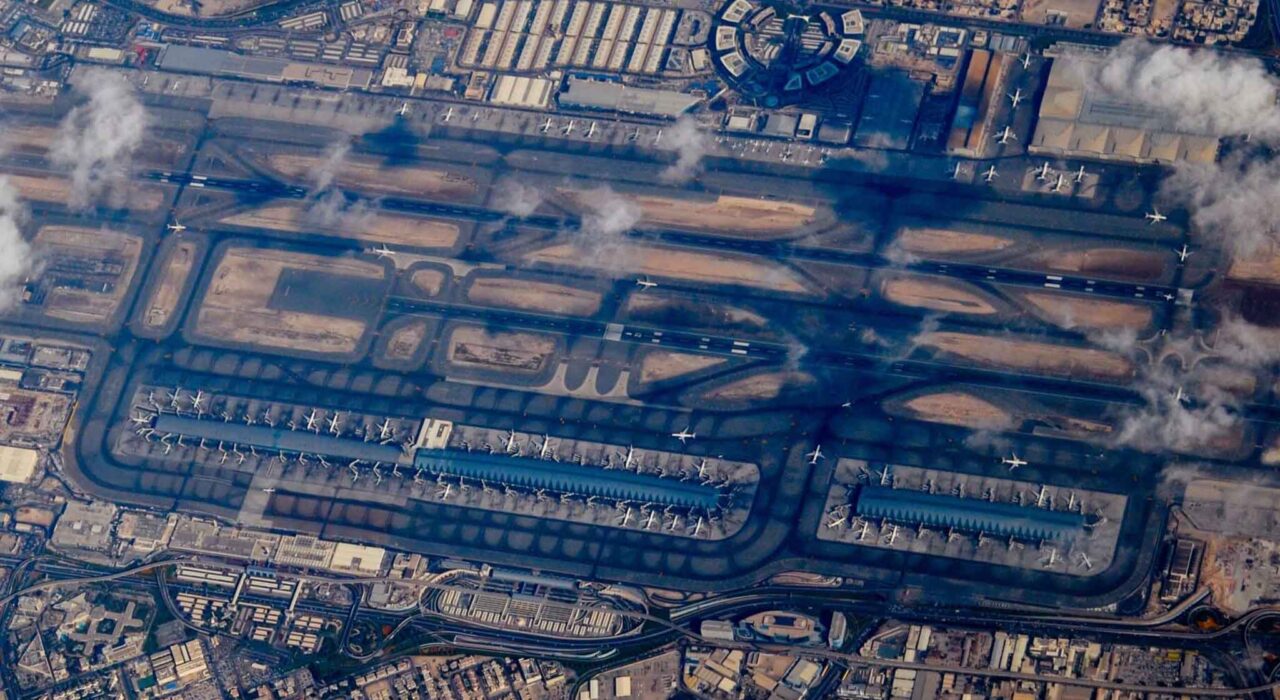
Flights have been suspended at Dubai International Airport, the world’s busiest international airport, after US and Israeli military strikes on Iran triggered widespread airspace closures across the Gulf.
Around 250,000 passengers typically travel through Dubai each day. Operations were halted following what US President Donald Trump described as a “major combat operation” against Iran.
Iran and Iraq subsequently closed their airspaces, prompting disruption across the region. Explosions have been reported in parts of the Middle East, including Bahrain and the UAE both home to US military bases, as well as in Jordan and Qatar.
Dubai-based carrier Emirates confirmed it had temporarily suspended all operations to and from Dubai until 3pm UAE time (11am GMT) on Sunday 1st of March.
In a statement, the airline said the safety of passengers and crew remained its highest priority, adding that updates would follow once airspace restrictions were lifted.
Meanwhile, Qatar Airways announced it had also suspended all flights to and from Doha following the closure of Qatari airspace.
The airline said it was working with government authorities to support affected passengers and had deployed additional ground staff at Hamad International Airport and other key airports.
It warned that further delays were expected once services resume.
Doha is second only to Dubai in terms of passenger traffic in the Gulf, making the twin suspensions among the most significant aviation disruptions in recent years.
Thousands of British travellers are understood to be affected, particularly those returning from Asia, Australasia and Africa via Gulf hubs. Several long-haul flights have been diverted.
Multiple Qatar Airways departures from European cities, including Berlin, Brussels, Zurich, Vienna, Warsaw, Barcelona, Stockholm, Copenhagen, Düsseldorf, Paris, Milan and Madrid were forced to return to their points of origin.
Airlines are expected to continue rerouting aircraft around restricted airspace, potentially adding hours to flight times and disrupting onward connections worldwide.
Aviation analysts say the closure of major Gulf hubs has immediate global consequences, given their central role linking Europe with Asia, Africa and Australasia.
Passengers have been advised to check directly with airlines before travelling to the airport as the situation develops.
Powered by
Asian Connect &
Business Connect